

How Automated Trading is Reshaping Modern Finance
Key Takeaways:
- Automated trading systems are transforming financial markets by increasing speed and efficiency.
- Artificial intelligence (AI) and machine learning are central to developing sophisticated trading algorithms.
- While offering numerous benefits, automated trading also presents challenges, including market volatility and regulatory concerns.
Table of Contents:
- Introduction
- Evolution of Automated Trading
- Role of AI in Automated Trading
- Benefits of Automated Trading
- Challenges and Risks
- Regulatory Landscape
- Future Trends
- Conclusion
The rise of automated trading has fundamentally changed the landscape of global finance. This approach, sometimes referred to as algorithmic trading, uses powerful computer systems to execute trades rapidly based on pre-programmed criteria, reducing the need for manual intervention and enabling unprecedented market efficiency. With complex markets and the vast amount of financial data available today, institutions are increasingly turning to automation to stay competitive and manage risk.
Central to this transformation are trade order management systems, which orchestrate the seamless execution of trades, manage portfolios, and track compliance in real time. The best platforms leverage the latest technologies to ensure every trade is performed with precision and minimal latency, connecting traders to global markets in ways that would have been unimaginable only a decade ago.
Financial professionals are witnessing the advantages of faster execution and deeper insights as advanced algorithms and machine learning models analyze market signals. This technology revolution helps organizations capitalize on short-lived opportunities and reduce manual errors, fostering a more efficient and competitive financial ecosystem.
While the adoption of automated trading brings clear benefits, it also introduces new complexities. Regulatory bodies are working hard to keep pace with the evolution of trading technologies, ensuring transparent and stable markets for all participants.
Automated trading has come a long way since its early days of basic rule-based executions intended to distribute large trades without disrupting markets. These early systems set fixed thresholds and executed buy or sell orders when predetermined conditions were met. As technology matured, the field saw the rise of high-frequency trading (HFT), in which trades are executed in milliseconds and often rely on highly sophisticated algorithms. By 2016, HFT accounted for up to 40 percent of equity trading volume, underscoring how quickly automation has taken hold.
This rapid evolution was accelerated by improvements in hardware, greater access to financial data, and the development of more advanced mathematical models. Today, automated trading spans asset classes, including equities, futures, foreign exchange, and cryptocurrencies, reshaping how liquidity is provided and how risks are managed.
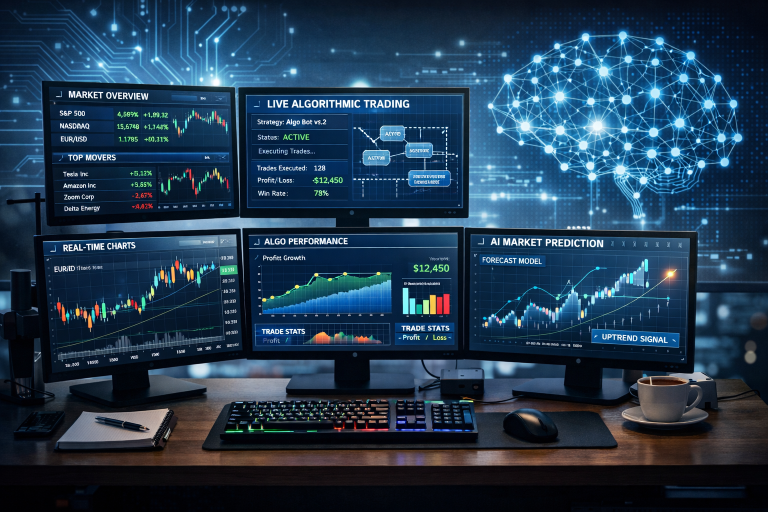
Role of AI in Automated Trading
The integration of artificial intelligence has propelled automated trading into a new era. AI and machine learning algorithms process huge, unstructured datasets, identifying market trends and opportunities that may be invisible to human traders. These models use techniques such as natural language processing and deep neural networks to incorporate alternative data sources, such as news feeds and social sentiment, into their analysis.
Innovative models, such as Deep Q-Networks, have demonstrated the ability to continuously learn and adapt by analyzing both historical and real-time data and adjusting trading strategies dynamically. This allows financial institutions to improve returns, reduce risk, and maintain a robust edge in increasingly crowded markets. Peer-reviewed research continues to ratify the benefits of AI-driven models, highlighting their role in reducing costs and enhancing portfolio performance.
Benefits of Automated Trading
There are several critical benefits realized through the adoption of automated trading systems:
- Speed and Efficiency: Algorithms execute trades at a pace and efficiency that far exceed human capability, often capturing gains from fleeting market movements that manual traders could not act upon quickly enough.
- Cost Reduction: Automation reduces personnel costs and operational overhead by minimizing manual interventions and streamlining back-office processing.
- Elimination of Human Emotion: Automated traders adhere strictly to logic and pre-coded criteria, removing emotional factors such as panic or overconfidence that can negatively impact decision-making.
Additionally, these systems enable enhanced back-testing and risk management by allowing traders to evaluate how strategies would have performed under varied market conditions, facilitating smarter, data-driven decisions.
Challenges and Risks
Despite the efficiency gains, automated trading introduces significant new risks. The same speed that offers competitive advantages can also exacerbate market volatility. Rapid-fire algorithms may contribute to sudden price swings, as seen in infamous “flash crash” events that temporarily disrupt pricing and liquidity. Automated errors, such as coding mistakes or systemic failures, can lead to substantial financial losses before operators have time to intervene.
- Market Volatility: Sudden market shifts, triggered or exacerbated by the collective actions of automated systems, can cause price volatility and even prompt temporary exchange shutdowns.
- Technical Failures: System outages, connectivity issues, or code bugs can expose participants to unpredictable risks and significant losses. Thorough testing and real-time system monitoring are essential precautions.
- Regulatory Scrutiny: Regulators face challenges in understanding and monitoring the sophisticated nature of these algorithms, raising concerns over transparency, market fairness, and stability.
Extensive oversight and robust risk management systems are increasingly required to contain these risks, underscoring the complexity automation can bring to modern financial markets.
Regulatory Landscape
To address the rapid rise of automated trading, regulatory bodies around the world have responded with comprehensive frameworks to mitigate risks and ensure fair markets. The Markets in Financial Instruments Directive II (MiFID II) in Europe stipulates rigorous requirements for firms engaged in algorithmic trading, demanding robust risk controls, transparency, and ongoing oversight. Similarly, the U.S. Securities and Exchange Commission enforces strict reporting and monitoring requirements and investigates anomalies and manipulative behavior in fast-moving electronic markets.
These global efforts highlight the need for continuous collaboration between industry participants and regulators, especially as trading strategies and technologies evolve.
Future Trends
The ongoing development of artificial intelligence and machine learning will further shape the future of automated trading. We are likely to see algorithms that can self-optimize, leveraging increasingly complex data sources for predictive trading and adaptive risk management. Moreover, the ease of access to powerful platforms is opening the door for retail investors to participate with the same sophistication that has historically been reserved for institutional players.
Alongside these advancements, regulatory frameworks will also continue to mature. The ongoing digital transformation demands vigilant oversight to ensure that markets remain transparent, inclusive, and resilient amid technological disruption.
Conclusion
Automated trading is profoundly reshaping the world of finance, bringing remarkable gains in efficiency, speed, and strategic flexibility. As the sophistication of AI and machine learning grows, and as participation increases across both institutional and retail segments, the importance of strong oversight and constant adaptation becomes clear. Moving forward, a collaborative approach between industry participants and regulators will be key to realizing the benefits of automation while managing its inherent risks for a more robust financial system.
