

How Strategic Planning Enhances Marketing Effectiveness
Key Takeaways
- Strategic planning aligns marketing initiatives with overarching business objectives, bridging the gap between vision and execution. With alignment, every marketing activity serves a clear purpose, contributing to the company’s larger mission rather than merely filling calendar space.
- Effective resource allocation through strategic planning helps maximize returns and minimize wasted effort. By focusing on data-driven insights rather than assumptions, companies can invest in high-performing channels and minimize budget drain.
- Performance tracking and optimization drive continual improvement, giving businesses a competitive edge. The ability to learn from results and act quickly can distinguish successful marketers in crowded industries.
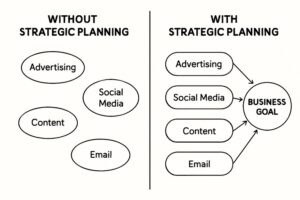
Many organizations are eager to drive results through their marketing activities, but often move forward without a cohesive direction. This often happens despite having talented teams and significant budgets because the lack of a well-defined strategy usually means efforts are scattered and lack a central vision. This can result in fragmented messaging and resources that provide minimal returns. Departments may operate in silos or pursue isolated campaigns, further exacerbating inconsistencies in outreach and diluting the brand’s overall impact. To avoid these pitfalls, businesses can leverage marketing strategy as part of a broader strategic planning process. Strategic planning synchronizes marketing campaigns with long-term business goals, enhancing measurable value and growth. It enables organizations to adapt to evolving competition and consumer behaviors, facilitating a cohesive marketing framework. By focusing on aligned strategies, businesses remain agile and avoid misaligned efforts, leading to efficient resource use. This approach fosters storytelling that resonates with audiences, builds brand credibility, and cultivates trust and loyalty. Industry leaders demonstrate that ongoing strategic initiatives are crucial for sustained growth, affirming that strategic planning is a vital, ongoing process rather than a mere annual formality.
Aligning Marketing with Business Goals
The foundation of effective marketing is ensuring alignment with the business’s core objectives. Without this, even the most creative campaigns can miss the mark, failing to advance meaningful business outcomes. When marketing strategies are developed with clear, measurable goals that tie directly to the company’s mission, every action becomes purposeful. For instance, if increasing customer retention is a top priority, all campaigns should directly or indirectly support this aim by providing value and nurturing relationships at every touchpoint. This alignment ensures marketing activities not only generate leads but also deliver value to the business, from acquisition through long-term engagement and loyalty. Over time, this tight linkage between goals and actions yields stronger performance and higher returns for the organization as a whole.
Efficient Resource Allocation
Strategic planning enables organizations to allocate their resources where they will have the greatest impact. This means carefully considering which channels produce the best engagement and allocating time and budgets accordingly. For instance, analytics may reveal that a company’s target demographic is highly active on social media, so resources are shifted from traditional advertising to digital platforms. Companies benefit by focusing less on scattered efforts and more on strategies with proven records. Resource allocation becomes less about blanket investing and more about optimizing spend, such as allocating more resources to digital marketing channels that outperform traditional media or to content marketing campaigns that drive organic search growth. Through effective planning, expenses are not only justified but also continuously optimized as new insights become available.
Enhanced Decision-Making
With a detailed strategic plan, marketing teams can efficiently evaluate opportunities and potential roadblocks. They no longer have to guess or rely on gut feelings; instead, they can reference objective criteria and historical trends. Decisions are anchored in pre-defined objectives and supporting data, reducing risk and fostering proactive rather than reactive actions. Strategic frameworks also help teams anticipate industry shifts and risks, enabling the development of mitigation plans and flexible adjustments as needed. Planning can reveal gaps in capabilities, highlight emerging market threats, and prioritize investments in innovation or technology upgrades. This support structure elevates confidence among stakeholders and streamlines collaboration across departments, ensuring every part of the organization moves in the same direction and maximizes collective impact.
Consistent Brand Messaging
A unified marketing strategy ensures that all customer touchpoints reflect the same brand values and promises. This cohesion is crucial, as fragmented messages can confuse consumers and erode trust. Consistency in message not only distinguishes the brand but also builds trust and loyalty with audiences. Whether engaging on social media, through the company website, or with direct advertising, audiences receive reinforced value propositions. Consistent messaging is directly linked to stronger brand equity and consumer trust. Repeating core messages makes a business memorable, while consistent adherence to brand voice and visual identity provides reliability, an essential factor in crowded, competitive markets.
Data-Driven Optimization
Modern marketing thrives on measurement and adaptation. Data-driven marketing provides real-time insights that empower teams to pivot quickly and effectively. Strategic planning prioritizes the tracking of key performance indicators (KPIs) to evaluate every campaign’s effectiveness, not just in terms of immediate results like clicks or impressions, but also in downstream effects such as conversions and retention. With granular insights, businesses can pause underperforming campaigns, reallocate resources, and experiment with new tactics that optimize results. Regular performance reviews empower organizations to learn from successes and failures, making continual improvement a key part of their marketing DNA and ensuring each new initiative builds on the lessons of the last.
Adaptability to Market Changes
Market dynamics can shift with little warning due to new technologies, competitive pressure, or evolving consumer behaviors. Businesses that rely solely on gut instinct or rigid plans often find themselves reacting too late or missing opportunities altogether. Strategic planning equips businesses with the structure to regularly revisit and update their strategies before challenges become critical. This cycle of refinement helps organizations not only respond to current trends but also anticipate future needs and stay ahead of competitors. Having documented processes and contingency plans in place enables a rapid response to disruptions without losing momentum or diluting brand integrity.
Conclusion
Strategic planning is essential for marketing teams seeking to drive sustained growth and market relevance. Far beyond a set-and-forget exercise, it is an ongoing process that marries business vision with tactical execution. Organizations that prioritize clear goal alignment, optimized resources, informed decision-making, consistent messaging, data-driven refinement, and adaptability position themselves for long-term marketing success. By embracing this disciplined planning approach, businesses can transform scattered marketing activities into cohesive strategies that win in any market environment and maintain a competitive advantage for years to come.
